Definitions
Calibration Drift: When an Agent's Confidence Stops Tracking Its Accuracy
Calibration drift is the failure mode where an agent's expressed confidence in its own output separates from that output's actual correctness over the course of a session, growing more confident, less confident, or simply noisier without any change in how right the agent actually is. Distinct from sycophantic drift and context rot, grounded in multi-turn calibration research spanning self-anchoring, reasoning-budget effects, and mechanistic circuit analysis, with detection and mitigation patterns.
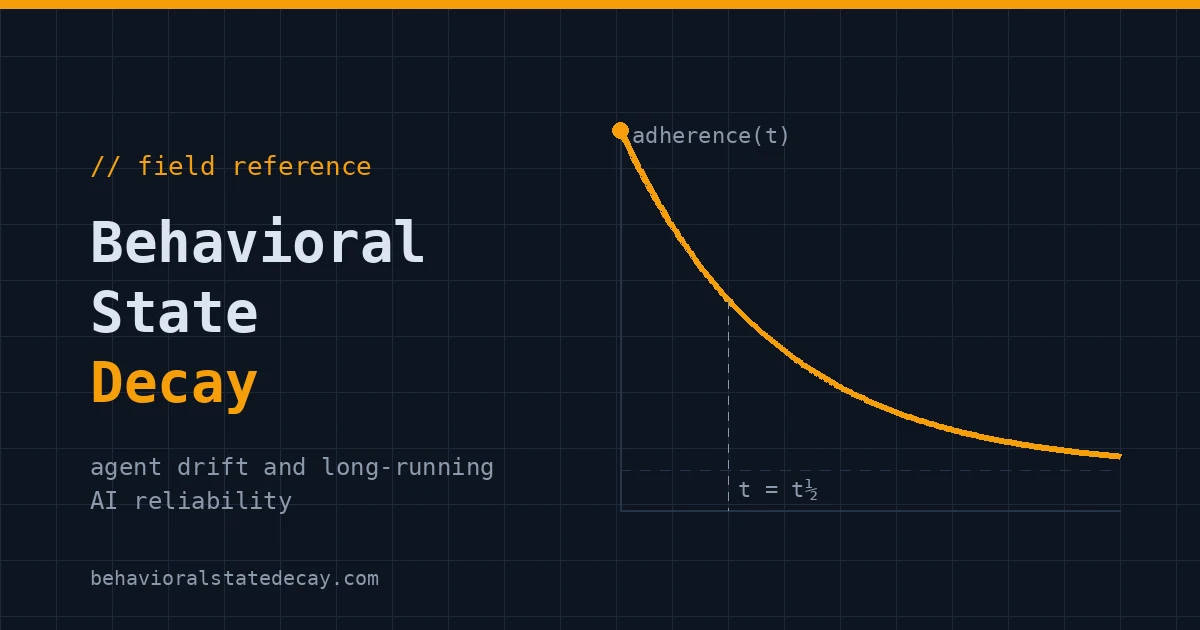
Calibration drift is the failure mode where the gap between an agent's stated confidence and its actual accuracy widens over the course of a session, independent of whether the agent's answers themselves are getting better or worse. A coding agent that was well-calibrated on turn one, saying "I'm fairly sure" on things it usually gets right and hedging on things it usually gets wrong, can by turn twelve be expressing high confidence at a rate that no longer tracks its hit rate at all. Nothing about its accuracy needs to have changed for this to happen. What changed is the reliability of the number it attaches to its own output, which is precisely the number a downstream system, a human reviewer, or an orchestrating agent uses to decide how much scrutiny that output deserves.
This is a different target from adjacent drift patterns already covered here. Sycophantic drift is a verdict reversing under user pushback; calibration drift can occur with the verdict held constant, correct or incorrect, while only the confidence attached to it becomes unreliable, and it does not require any user disagreement to trigger it at all. Context rot is accuracy itself degrading as the context window grows long; calibration drift is specifically about the relationship between confidence and accuracy, and the two can move independently, an agent can stay just as accurate while becoming a worse judge of when it is right. It is also distinct from a general reliability audit like the one behind Quantifying Conversational Reliability, which tracks instruction drift, intent confusion, and contextual overwriting as failures of what the agent does; calibration drift is a failure of what the agent says about what it did.
Mechanism
The clearest evidence comes from a controlled study built specifically to isolate self-referential conditioning from the ordinary act of answering more than once. Self-Anchoring Calibration Drift (SACD) compares three conditions across three frontier models, Claude Sonnet 4.6, Gemini 3.1 Pro, and GPT-5.2, on 150 questions spanning factual, technical, and open-ended domains: a single-turn baseline, a multi-turn condition where the model builds iteratively on its own prior answers, and an independent-repetition control where the same question is re-asked without that self-referential chain (Harshavardhan, arXiv:2603.01239). The result is not a single universal direction, which is itself the finding worth carrying forward. Claude Sonnet 4.6 showed a significant confidence *decrease* under self-anchoring (mean drift score -0.032, t(14)=-2.43, p=.029, d=-0.627) alongside a significant rise in calibration error. GPT-5.2 showed the opposite sign in open-ended domains, confidence *increasing* (+0.026) with expected calibration error escalating by the fifth turn. Gemini 3.1 Pro showed no significant drift under self-anchoring at all, but its independent-repetition control revealed something separate worth noting: calibration error fell from .327 toward near zero across repeated independent asks, meaning re-asking without a self-referential chain can itself act as a mild corrective. Three frontier models, three different signatures, from the same experimental manipulation.
A second line of evidence locates a specific trigger inside reasoning-heavy agents rather than in conversational self-reference generally. Calibration Drift Under Reasoning (CDUR) shows that extending a model's chain-of-thought reasoning budget past a task-specific threshold flips a previously helpful dynamic into a harmful one: initially, more reasoning steps catch and correct errors, but beyond that threshold, additional reasoning increasingly produces wrong answers delivered with rising confidence rather than doubt (CDUR, arXiv:2606.11211). The relationship is non-monotonic, not a straight line, so a policy of "let it think longer" has no safe default; the same budget increase that improves calibration on one task class degrades it on another once the threshold is crossed. The authors' response, CABStop, is itself informative about where the fix has to live: it is an external stopping rule that halts reasoning when the model's confidence diverges from an auxiliary accuracy estimate, not an instruction asking the model to reason more carefully about its own certainty.
A third line of evidence reframes calibration itself as something that has to be measured across turns rather than once. Prior calibration research treated confidence as a static, single-turn property; a 2026 paper argues this misses where the failure actually happens, since user feedback across a conversation degrades a model's calibration in ways a single-turn ECE score cannot see, and introduces ECE@T, expected calibration error tracked at each turn, specifically to make the drift visible as a trajectory rather than a snapshot ("Confidence Should Be Calibrated More Than One Turn Deep," Zhang, Li, Liu, Shen, Liu, and Patras, arXiv:2604.05397). That a conversation-level metric was needed at all is the underlying point: single-turn calibration checks, still the norm in most eval harnesses, are structurally blind to this failure mode by construction.
A fourth line of evidence grounds the phenomenon below the level of behavior, in the model's internals. Mechanistic analysis of verbalized overconfidence identifies a small set of MLP blocks and attention heads, concentrated in middle-to-late layers, that consistently produce the confidence-inflation signal at the point where a model commits to its final answer token ("Wired for Overconfidence," Zhao, He, Zheng, Zhang, and Chen, COLM 2026, arXiv:2604.01457). Targeted inference-time interventions on those specific circuits substantially improved calibration in testing. This matters for how the pattern should be understood: it is not purely a conversational or prompting artifact that better instructions could dissolve, it has an identifiable, targetable mechanism inside the model that produces the inflation signal regardless of what the prompt says.
How to detect it
- Track calibration per turn, not once per session. Adopt an ECE@T-style metric that scores expected calibration error at each turn of a trace rather than a single aggregate; a flat single-turn ECE computed at the end of a long run will not reveal that turns 3 through 9 drifted and turn 10 happened to land back on trend.
- Run the SACD three-condition protocol on your own agent before trusting any single number: compare confidence on a fresh single-turn ask, confidence built iteratively on the agent's own prior turns, and confidence on the same question re-asked independently. The gap between the second and third conditions isolates self-referential conditioning specifically, as distinct from ordinary multi-turn task drift.
- For any agent using extended or budgeted reasoning, sweep the reasoning-token budget against ECE on a fixed task set and look for the CDUR signature: calibration improving, then reversing past some threshold. A monotonic assumption, more thinking is always safer, is exactly the assumption this data contradicts.
- Separate confidence tracking from accuracy tracking entirely, and stratify by whether a turn's answer restates a prior turn's answer or represents an independent new judgment; a model can hold accuracy constant while its confidence on restated answers inflates.
- Do not reuse a sycophantic-drift probe suite for this. A flip-rate metric tracks whether the verdict changed under pushback; calibration drift can be fully present, a real, measurable divergence, while the verdict never changes at all, so the two probe suites need to run separately and neither substitutes for the other.
Mitigation
Enforce an external stopping or escalation rule rather than trusting the model's self-reported number to self-correct. CABStop's approach, halt or flag when confidence diverges from an independent accuracy estimate, generalizes past its reasoning-budget origin: any agent whose actions are gated on stated confidence should have that gate checked against something the model did not generate itself, not against the number it is currently anchored on.
Recompute confidence rather than carrying it forward. Since SACD's mechanism is specifically self-referential conditioning, an agent building its Nth-turn confidence by adjusting its (N-1)th-turn confidence is the exact pattern under study. Where feasible, derive a fresh confidence estimate from the evidence available at the current step instead of incrementally revising a running number, the same discipline argued for the underlying facts themselves in state externalization, applied here to the confidence score rather than only to the claims it's attached to.
Do not apply a single universal correction factor across models or expect the direction of drift to transfer. SACD found opposite-signed drift in two frontier models and no significant drift in a third, from the identical experimental manipulation. A fixed discount applied to "the model's confidence" assumes a single, stable relationship between the stated number and reality that the evidence says does not hold across models, and likely does not hold across your own agent's task types either without being checked directly.
Where the deployment is on an open-weight model, treat circuit-level recalibration as a real option rather than only a research curiosity. The demonstrated result, that a small, identifiable set of components drives the inflation signal and that intervening on them at inference time improves calibration, means the fix does not have to live entirely in the prompt or the harness for models where internals are accessible.
Audit confidence as its own artifact, separately from the verdict it's attached to. A verdict can remain correct for the entire length of a session while the confidence number riding alongside it becomes progressively less trustworthy; any system that makes decisions based on an agent's stated certainty, auto-approving high-confidence outputs, escalating low-confidence ones, needs that certainty checked on its own terms, not inferred from whether the underlying answer happened to be right.
Related terms
- Sycophantic drift: a verdict reversing under user pushback; calibration drift is the confidence attached to a verdict becoming unreliable, which can happen with no reversal and no pushback at all.
- Context rot: accuracy itself degrading as a single agent's context window grows long; calibration drift tracks the relationship between confidence and accuracy, which can worsen even while accuracy holds steady.
- State externalization: the recompute-rather-than-carry-forward discipline this article's main mitigation applies specifically to a confidence score.
- LLM-as-judge for drift detection: a judge model's own confidence in its verdicts is exposed to the identical mechanism described here, worth checking if a judge is used to score any of the drift patterns on this site.
- Agent drift: a taxonomy: the broader classification this pattern sits within, closest to the taxonomy's behavioral drift manifestation.
FAQ
Is calibration drift the same as an agent just becoming less accurate? No. Accuracy is whether the answer is right. Calibration is whether the stated confidence matches the rate at which answers like it are right. An agent can stay exactly as accurate across a session while its confidence numbers become progressively worse predictors of that accuracy, which is the specific failure this term names.
Does calibration drift always mean the agent gets overconfident? No, and the evidence argues against assuming a single direction. The SACD study found one frontier model growing significantly less confident under self-anchoring, another growing more confident with rising calibration error, and a third showing no significant drift at all, from an identical experimental setup. Direction has to be measured per model, not assumed.
Does this only affect agents that use extended chain-of-thought reasoning? No. SACD and the multi-turn ECE@T research both observed drift from ordinary multi-turn conversation, without any explicit reasoning budget involved. CDUR specifically implicates reasoning budget as one trigger among several, not the only one; an agent with no visible reasoning trace can still exhibit calibration drift from self-referential conditioning alone.
Can prompting fix it? Only partially. Prompting can ask a model to hedge more or state uncertainty more often, but the mechanistic evidence traces the inflation signal to specific internal circuits that produce it at the point of answer commitment, and the multi-turn evidence shows the effect compounding across turns in model-specific directions. Treat prompting as one lever among several, alongside external stopping rules, recomputed rather than carried-forward confidence, and, where internals are accessible, targeted circuit-level intervention.