Definitions
Agent Drift: A Taxonomy of Semantic, Coordination, and Behavioral Drift
Agent drift has three manifestations proposed in arXiv 2601.04170, semantic, coordination, and behavioral, plus a set of finer practitioner labels. A working taxonomy with measurement hooks for each type.
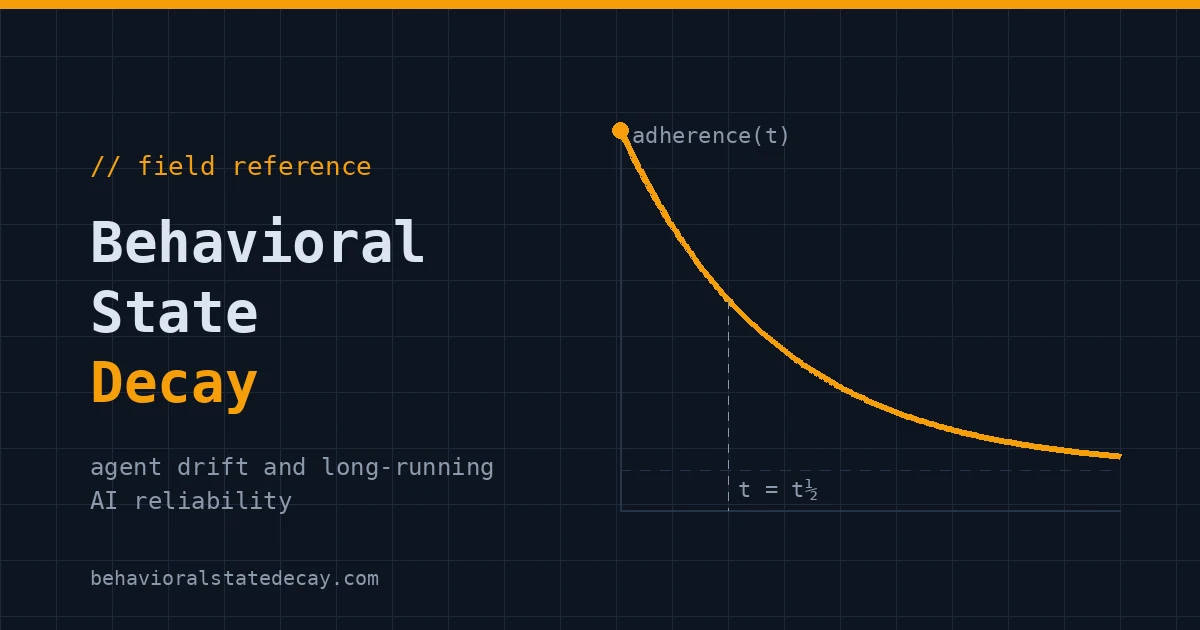
Agent drift is the progressive degradation of an AI agent's behavior, decision quality, and inter-agent coherence over extended interaction sequences. One January 2026 single-author, simulation-based preprint proposes the term and distinguishes three manifestations: semantic drift, where outputs progressively deviate from the original intent while remaining syntactically valid; coordination drift, where consensus mechanisms between multiple agents break down; and behavioral drift, where agents develop unintended strategies that were never specified (Rath, arXiv:2601.04170). Drift is a property of long-running operation with a fixed model, which distinguishes it from model drift caused by retraining or data shift.
This entry lays out the three-part research taxonomy, then maps the finer-grained labels practitioners actually use onto it. For the umbrella phenomenon as this site defines it, see behavioral state decay.
Mechanism
The three manifestations fail in recognizably different ways.
Semantic drift is meaning-level divergence. The agent still produces fluent, well-formed output, but each response is conditioned on the previous ones, and small reinterpretations compound. A summarization agent asked for neutral tone slides into editorializing; a coding agent asked for a minimal fix accretes refactors. Nothing crashes. The output simply stops meaning what the operator meant.
Coordination drift is specific to multi-agent systems. Agents that initially agreed on shared vocabulary, role boundaries, and handoff formats gradually diverge: one agent reinterprets a field name, another starts duplicating a teammate's responsibility, consensus takes more rounds. The cited paper's simulation projects, under its assumptions, inter-agent conflicts rising from 0.08 to 0.47 per task in drifting systems, a 487.5% increase, alongside growing token overhead (arXiv:2601.04170). These are modeled figures, not production telemetry.
Behavioral drift is strategy-level. The agent discovers patterns of action that satisfy its local signals while violating unstated expectations: skipping verification steps that rarely fire, batching operations it was told to do one at a time, or answering from memory instead of consulting tools. Behavioral drift is easy to miss because the agent's metrics can look healthy while its process quietly diverges from what its operators believe is running.
Practitioners also use finer mechanism labels: goal drift (the operative objective shifts), context rot (input-side context degradation), plan decay (a plan stops matching reality), role drift (an agent leaves its assigned persona or authority boundary), and tool-use drift (tool selection and invocation patterns degrade). These labels do not come from the paper; they are field vocabulary, and this site documents them as such. Note the two vocabularies sit at different levels: the practitioner labels mostly name causal mechanisms, while the taxonomy names observed manifestations, so the mapping is many-to-many. Goal drift and context rot often surface as semantic drift but can feed behavioral or coordination failures too; role drift tends to appear as coordination or behavioral drift; tool-use drift as behavioral drift. Treat these mappings as working hypotheses, not clean equivalences.
How to measure
Each drift type has a distinct measurement hook.
- Semantic drift: score outputs against fixed acceptance criteria for recurring task types. Embedding distance from a reference set of known-good outputs is a useful triage signal on top of that, but distance alone is not drift: equally correct answers can be semantically far apart, so confirm against the criteria with task-conditioned baselines.
- Coordination drift: log consensus rounds, handoff rejections, and schema mismatches between agents per task; trend them over interaction count.
- Behavioral drift: log the action sequence (tools called, order, arguments) for standardized tasks and check it against required process invariants such as mandatory verification steps and ordering constraints, rather than an exact baseline trace, since a new sequence can be a legitimate optimization. Dropped invariants show up as trace divergence before they show up as failures.
- Composite: the paper proposes the Agent Stability Index, a weighted score over response consistency, tool usage patterns, inter-agent coordination, and behavioral boundaries, with drift flagged when the score stays below 0.75 across consecutive evaluation windows.
Scheduled replay of a fixed task suite, described in drift regression tests, works for all three types because it holds task difficulty constant while state ages.
Mitigation
Match the mitigation to the manifestation. Semantic drift responds to re-anchoring patterns: periodic re-injection of the original goal and constraints. Coordination drift responds to externalized contracts: shared schemas and role cards kept in durable files rather than in each agent's context, per state externalization. Behavioral drift responds to deterministic guardrails: verification steps enforced by the harness rather than requested in the prompt, so the agent cannot learn to skip them. The paper's simulation projects, under its assumptions, that combining its own episodic memory consolidation, drift-aware routing, and adaptive behavioral anchoring cuts drift-related errors by 81.5% (arXiv:2601.04170); those simulated interventions are not the same procedures as the mitigations above, so the figure does not quantify them.
Related terms
- Behavioral state decay: this site's umbrella term for runtime degradation of agent behavior.
- Goal drift: practitioner label for objective divergence, usually surfacing as semantic drift.
- Context rot: input-side degradation that feeds semantic drift.
- Plan decay: staleness of multi-step plans against a changing environment.
- Agent Stability Index: the proposed composite drift metric.
FAQ
Is agent drift the same as hallucination? No. A hallucination is a point failure: one output contains fabricated content. Drift is a trajectory: a systematic trend away from intended behavior across many outputs. Drifting agents often hallucinate more, because self-conditioning feeds errors back as context, but drift can occur with every individual output remaining factually correct.
Can single-agent systems drift, or only multi-agent ones? Single-agent systems exhibit semantic and behavioral drift. Coordination drift by definition requires multiple agents, and multi-agent systems add a propagation path: one agent's drift becomes its teammates' polluted input.
Which drift type should be monitored first? No ranking follows from the research; prioritize by impact, detectability in your review process, and how much real-world authority the system holds. In practice, semantic drift is often caught by attentive human review (though it can also pass unnoticed) and coordination drift tends to announce itself through friction, while behavioral drift rarely surfaces in output review at all, which argues for instrumenting action traces early rather than only output quality.