Mitigation
Re-Anchoring Patterns: Restoring Goal and Role Alignment Mid-Run
Re-anchoring re-injects an agent's goal, role, and constraints mid-run to counter drift without discarding session progress. The main patterns, a concrete procedure, and the failure modes to avoid.
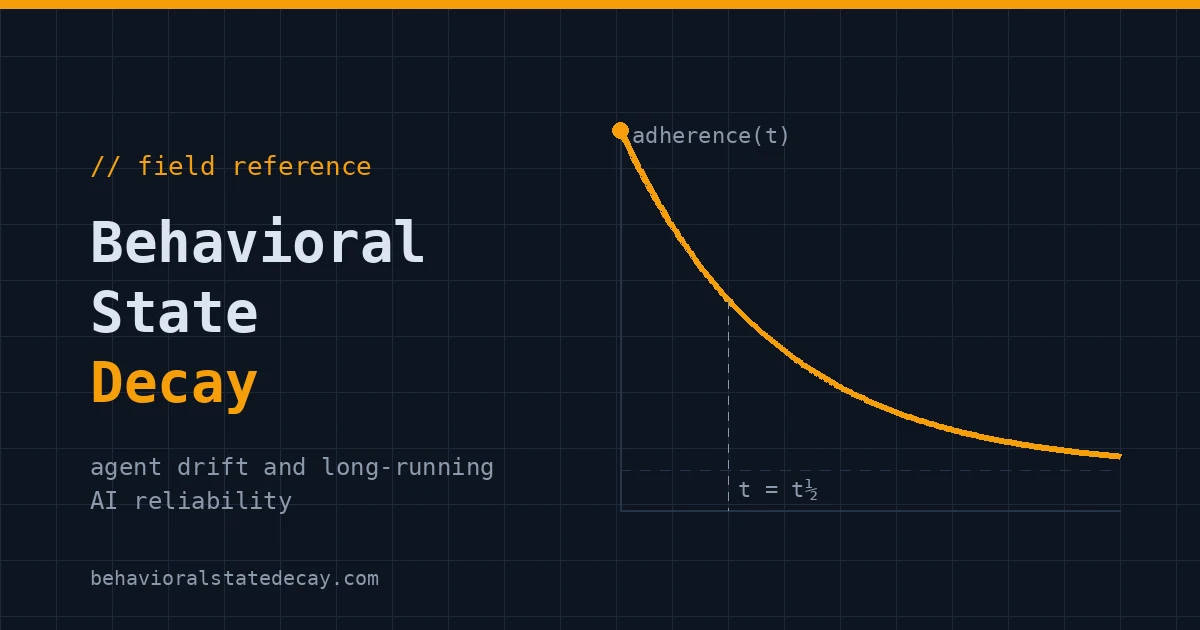
An agent's goal statement, role definition, and constraints are written once, at the top of a session, and then age. Compactions abridge them, distractors accumulate around them, and the agent's own outputs gradually outweigh them as conditioning material; where they physically sit depends on the runtime's serialization and compaction strategy, but the practical effect is that early instructions become harder for the model to use. The result is goal drift and instruction loss driven by context rot: the anchor still exists in the transcript, but it no longer steers. Killing the session recovers alignment at the cost of all accumulated progress. Re-anchoring is the middle path: deliberately restoring the anchor mid-run.
The method
Re-anchoring re-injects the authoritative goal, role, and constraint set into the high-attention recent region of the context, and forces the agent to reconcile its current trajectory against it. The research literature models a related family as adaptive behavioral anchoring, and the paper's simulation projects, under its assumptions, a 70.4% reduction in drift from that intervention alone (Rath, arXiv:2601.04170). What was simulated is drift-weighted few-shot augmentation using baseline exemplars, a materially different procedure from the goal, role, and constraint-file re-injection described here, so the figure does not quantify this article's procedure.
Four patterns cover most needs:
- Scheduled re-anchor: re-inject the anchor block every K tasks or before each work phase. Cheap, predictable, and the default.
- Triggered re-anchor: fire on a drift signal instead of a clock, such as an Agent Stability Index alert or a failed probe in your drift regression tests. Costlier to build, better targeted.
- Compaction-coupled re-anchor: every time history is summarized, prepend the verbatim anchor to the compacted context rather than letting summarization paraphrase it. Summaries drift; the anchor must not.
- Fresh-session re-anchor: when state is too polluted to save, start a new session seeded with the anchor plus a minimal verified state file, per state externalization. This is re-anchoring by rebirth and the reliable last resort.
Concrete procedure
- Step 1: write the anchor as a durable artifact, not a prompt paragraph: objective, success criteria, explicit exclusions, role and authority boundaries, and hard constraints. Keep it under a page; an anchor that cannot be re-read cheaply will not be re-read.
- Step 2: version it. If the operator amends the goal, the anchor file changes and the change is logged. The agent never edits its own anchor.
- Step 3: choose triggers: a fixed cadence as baseline, plus event triggers (after compaction, after any precondition failure, before irreversible actions).
- Step 4: on trigger, re-read the anchor file into the recent context, then run a reconciliation probe. In pseudocode: restatement = agent restates objective and next steps; diff = compare(restatement, anchor), checking the anchor's enumerated constraints one by one rather than judging overall similarity; if any constraint is missing or altered, have the agent regenerate its next plan directly from the authoritative anchor, since a verbal acknowledgment alone can be performative, and gate continuation on passing an independently scored goal-sensitive probe; log the comparison either way.
- Step 5: track drift-at-reconciliation over time. Rising diffs mean your cadence is too slow or your state hygiene is failing upstream.
Pitfalls
- Anchor bloat. Each incident tempts you to append another rule until the anchor is pages long and itself subject to middle-of-context weakness. Keep it minimal and move detail to linked references.
- Paraphrase decay. Letting the agent or the compactor restate the anchor in its own words substitutes a drifting copy for the fixed original. Re-inject verbatim, always.
- Mid-chain interruption. Re-anchoring in the middle of a multi-step tool transaction can orphan half-completed operations. Re-anchor at task boundaries or checkpoints, not between a write and its verification.
- Overwriting learned corrections. A session accumulates legitimate mid-run amendments from the operator. If the anchor file was never updated with them, re-anchoring reverts the agent to an outdated brief. The fix is procedural: amendments go into the anchor file at the moment they are made.
- Anchoring a decayed plan. Re-anchoring restores the objective, not the plan's validity. If preconditions have failed, you also need re-planning, per plan decay; re-anchoring alone will send a well-aligned agent down a dead path.
- Treating re-anchoring as sufficient. It is one layer of mitigating behavioral state decay; without externalized state and drift measurement it degrades into ritual.
Checklist
- Anchor artifact exists: objective, criteria, exclusions, role, constraints, under one page.
- Anchor is versioned; operator amendments are written into it immediately.
- Baseline cadence plus event triggers (post-compaction, pre-irreversible-action, on drift alert) defined.
- Re-injection is verbatim, never paraphrased.
- Reconciliation probe runs at each re-anchor and its diff is logged.
- Re-anchor points respect task boundaries.
- Fresh-session fallback documented, with the minimal seed state defined.