Definitions
Behavioral State Decay: Definition, Mechanisms, and Why It Matters
This site's working definition of behavioral state decay in long-running AI agents: what degrades, why the decay does not require a model-weight or model-version change, how to measure it, and the mitigation patterns that help.
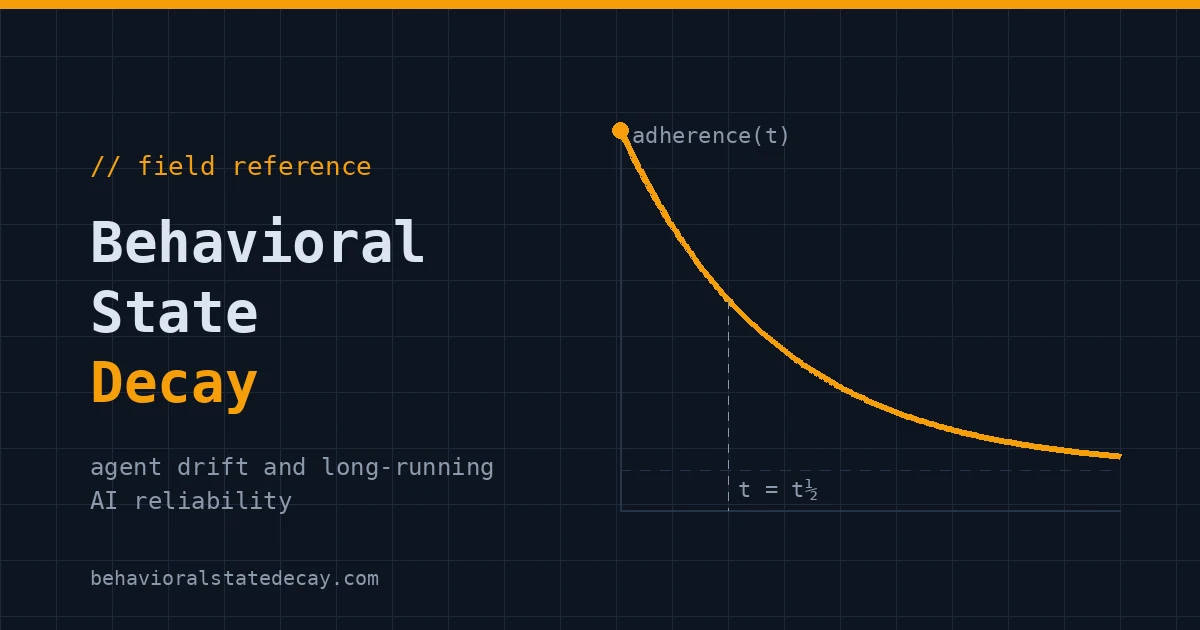
Behavioral state decay is the progressive degradation of an AI agent's effective behavior over a long-running session or deployment: instructions lose their grip, goals blur, plans go stale, and outputs drift away from the operator's intent even though the underlying model weights never change. It is a runtime phenomenon, a property of the agent's accumulated state (context window, memory, intermediate artifacts) rather than of the model itself. The practical consequence is that an agent which performed well on its first task can become quietly unreliable later in the run, without any single visible failure marking the transition.
The term generalizes a cluster of failure modes that practitioners report under different names: agent drift, context rot, goal drift, and plan decay. Each names a distinct mechanism, but they share one signature: performance is a function of session age, not just task difficulty.
Mechanism
Behavioral state decay arises because everything an agent uses to decide its next action is state that accumulates and degrades. Four mechanisms form a useful working taxonomy of how that happens.
First, context accumulation. Every turn appends tool output, retries, and partial results to the context window. Research by Chroma across 18 models found that LLMs do not process context uniformly: as input grows, performance on the same task declines, even on simple retrieval (Context Rot, Chroma, 2025). Earlier work measuring task performance found a positional effect as well: models often used information at the start and end of a long input more reliably than information in the middle (Liu et al., 2023). Where a system prompt or goal statement physically ends up depends on the runtime's serialization and compaction strategy, but the practical effect is consistent: as inputs grow and distractors accumulate, instructions written at minute one become harder for the model to use reliably by hour three.
Second, compaction loss. Long sessions force summarization or truncation of history. Each compaction is lossy, and what gets lost is disproportionately the quiet constraints: the edge case the operator mentioned once, the reason a particular approach was rejected. The agent keeps behaving, but against a simplified version of its own past.
Third, self-conditioning. An agent's outputs become its own inputs. Small deviations (a slightly wrong assumption, a mislabeled result) are read back as ground truth on later turns and compound instead of averaging out.
Fourth, environment divergence. The world changes while the agent runs: files are edited, tickets close, APIs return new data. State that was accurate at capture time silently becomes fiction, which is the core of plan decay.
A January 2026 preprint offers one quantitative simulation framework for this family of failures. It defines agent drift as "the progressive degradation of agent behavior, decision quality, and inter-agent coherence over extended interaction sequences" and its simulation projects, under its assumptions, a 42.0% reduction in task success rate for unchecked drift relative to stable baselines, with human interventions per task rising from 0.31 to 0.98 (Rath, arXiv:2601.04170). Those figures illustrate possible behavior under the paper's modeling assumptions; they do not estimate production incidence or effect size.
How to measure
Decay is invisible in per-task metrics because each individual output still looks plausible. Measurement therefore has to be longitudinal.
- Plot task success against session age or interaction count, not just against task type. A downward slope on fixed-difficulty tasks is the decay signature.
- Replay a fixed golden-task suite at intervals against the agent's current accumulated state, as described in drift regression tests.
- Track composite stability metrics. The Agent Stability Index proposed in the paper above scores response consistency, tool usage patterns, coordination, and behavioral boundaries on a 0 to 1 scale and flags drift when the score stays below threshold across consecutive windows.
- Probe the agent's operative goal directly: ask it to restate its objective and diff the answer against the original brief.
Mitigation
Mitigation patterns fall into two families. Prevention keeps state trustworthy: keep sessions short where possible, budget context deliberately, and move durable facts out of the context window into files and ledgers, a pattern covered in state externalization. Correction restores alignment mid-run: re-inject goal and role statements on a schedule or when a drift metric fires, as covered in re-anchoring patterns. The preprint cited above projects, again from its simulation and under its assumptions, that combining its own versions of memory consolidation, drift-aware routing, and behavioral anchoring reduces drift-related errors by 81.5%, at roughly 23% computational overhead (Rath, arXiv:2601.04170); those simulated interventions differ from the procedures described here, so the figure does not quantify them.
No mitigation eliminates decay. The goal of a well-run agent operation is to detect it early, bound its blast radius, and make recovery cheap.
Related terms
- Agent drift: the umbrella research term, with a taxonomy of semantic, coordination, and behavioral drift.
- Context rot: input-side degradation, where growing or polluted context reduces model performance.
- Goal drift: divergence of the agent's operative objective from the assigned objective.
- Plan decay: a formerly valid multi-step plan ceasing to match reality.
- Agent Stability Index: a proposed composite metric for quantifying drift.
FAQ
Is behavioral state decay the same as model drift? No. Model drift refers to a deployed model's performance changing because the data distribution or the model version changed. Behavioral state decay occurs with a frozen model: the weights are identical at hour one and hour ten, and what degrades is the accumulated session state the model conditions on.
Does a larger context window fix it? No. Larger windows delay truncation but do not remove positional weakness or context pollution; the Chroma results show degradation well inside advertised window sizes. More capacity without curation mostly means more accumulated noise.
How quickly does decay set in? It depends on task volume and state hygiene, not wall-clock time. The simulation study cited above projects, under its assumptions, detectable drift after a median of 73 interactions, though that result uses a looser criterion (a stability score below 0.85) than the paper's formal alarm rule (below 0.75 for three consecutive windows). Treat the figure as a description of the paper's simulation, and calibrate your own measurement cadence from your system's observed onset pattern, risk, and acceptable detection latency.