Definitions
Goal Drift in LLM Agents
Goal drift is the gradual divergence of an agent's operative objective from its assigned objective. How it develops without any single failure, how to detect it with goal probes, and how to correct it.
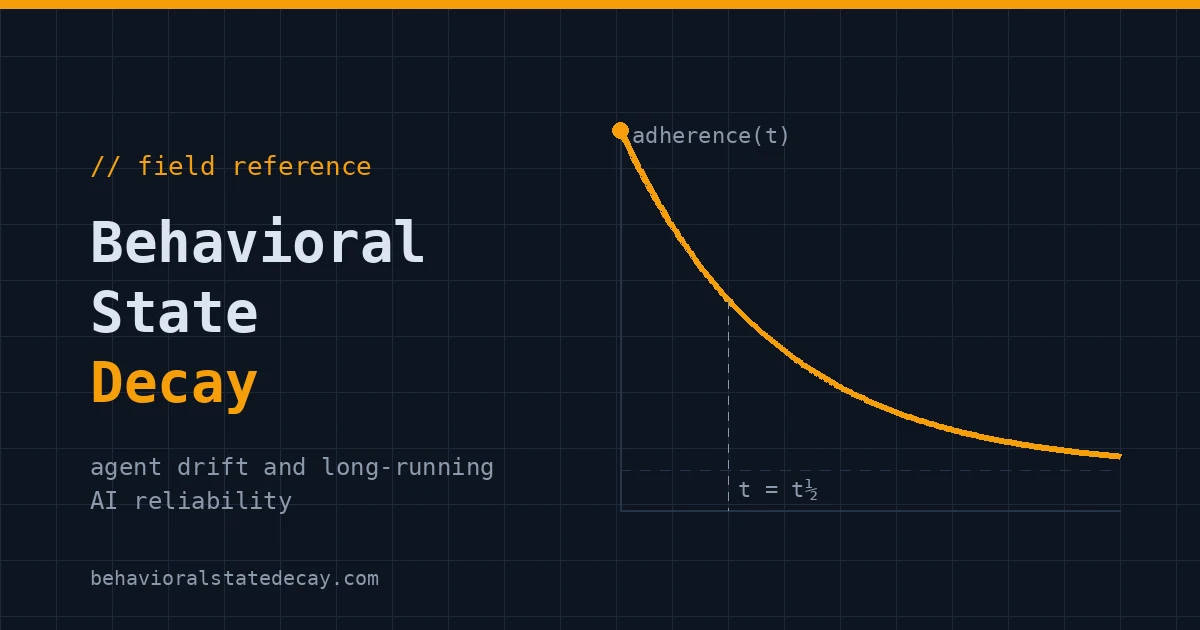
Goal drift is the gradual divergence of an LLM agent's operative objective, the goal its actions actually optimize, from its assigned objective, the goal its operator specified. The assigned goal remains in the record, but through summarization loss, reinterpretation, and attention decay over a long run, the agent begins pursuing a related but different target: a subtask promoted to the main task, a proxy metric substituted for the real outcome, or a plausible reading of an ambiguous brief that hardens into policy. No single step looks wrong; the endpoint does.
Goal drift is a practitioner term rather than a formally defined research construct. In the taxonomy of agent drift, it typically surfaces as semantic drift, and it is one of the most consequential forms of behavioral state decay because every downstream decision inherits the wrong objective.
Mechanism
Four paths lead from a correct goal to a drifted one.
Subgoal promotion. Multi-step work requires decomposing the goal into subtasks. Under context pressure, the currently active subtask crowds out the parent goal, and after a compaction or two the subtask is the only goal left in working memory. An agent asked to reduce build time may end the session optimizing one slow test it discovered along the way, long after that stopped being the highest-leverage work.
Proxy substitution. Agents grab measurable stand-ins for fuzzy outcomes: tests passing for correctness, word count for completeness, absence of errors for success. The proxy is reasonable at first and then optimized past the point where it tracks the real objective.
Compaction loss. Each summarization of session history restates the goal in fewer words. Qualifiers and exclusions are the first casualties, and the agent downstream of the summary faithfully serves the abridged goal. This is compaction acting specifically on the objective: the goal text is removed by summarization, which is distinct from context rot, where the text remains present but is used unreliably.
Interpretation hardening. Ambiguity in the original brief gets resolved silently by the agent's first plausible reading, which is then reinforced every turn by self-conditioning. The longer the run, the more expensive the misreading becomes to notice and unwind.
How to measure
The core technique is the goal probe: periodically require the agent to restate its current objective, success criteria, and exclusions in its own words, then diff that restatement against the original brief. Semantic distance between restatement and brief, trended over session age, is a useful but weak diagnostic: an agent can paraphrase the goal correctly while acting toward a different objective, and the probe itself can re-anchor the agent it is measuring. Pair it with structured checks of the brief's explicit constraints and with goal-sensitive probes whose actions and outcomes are scored against the authoritative brief.
- Run goal probes on a fixed cadence (for example every N tasks or before each irreversible action) and log the restatements.
- Score outcomes against the original acceptance criteria, not the agent's current framing of them. A rising gap between agent-reported success and criteria-based success indicates proxy substitution.
- Include goal-sensitive cases in your replayed suite, per drift regression tests: tasks where the drifted objective and the true objective produce different answers.
- In multi-agent systems, probe each agent separately; the Agent Stability Index framework's consistency dimensions offer a composite view, but divergence between agents' goal restatements is the earlier warning.
Mitigation
Prevention starts with an externalized goal artifact: the objective, success criteria, and explicit exclusions in a durable file the agent re-reads, rather than a paragraph decaying in the context window, per state externalization. Keep it verbatim; every restatement is an opportunity to drift. Correction is scheduled re-injection of that artifact and comparison of probe restatements against it, per re-anchoring patterns. A related mitigation appears in the simulation literature as adaptive behavioral anchoring, for which the paper's simulation projects, under its assumptions, a 70.4% drift reduction as a single intervention (Rath, arXiv:2601.04170); what was simulated is drift-weighted few-shot augmentation with baseline exemplars, a different procedure from the artifact-based re-anchoring described here, so the figure does not quantify this pattern. Finally, make ambiguity explicit at kickoff: an agent forced to enumerate open questions before starting has fewer silent interpretations to harden.
Related terms
- Behavioral state decay: the umbrella phenomenon.
- Agent drift: goal drift usually manifests as the semantic type.
- Context rot: the input-side mechanism that makes a still-present goal statement unreliable to use.
- Plan decay: the plan-level sibling; a fresh plan can serve a drifted goal, and a decayed plan can betray a correct one.
- Re-anchoring patterns: the primary corrective family.
FAQ
Is goal drift a safety problem or a quality problem? Both, at different scales. In routine operations it produces work that is polished but off-target, a quality and cost problem. In systems with real-world authority, an agent optimizing a proxy it was never given is a control problem, which is why goal probes are worth running even when output quality looks fine.
How is goal drift different from an agent simply misunderstanding instructions? Timing. Misunderstanding is present from turn one and shows up in early outputs. Goal drift begins from a correct understanding, demonstrably good early work, and degrades with session age. The distinction matters because the fixes differ: clearer briefs prevent misunderstanding, while re-anchoring and goal probes counter drift.
Can goal drift ever be useful adaptation? Sometimes an agent drifts toward what the operator actually needed rather than what was written. The safe pattern is to treat that as a proposal: the agent surfaces the discrepancy and the operator amends the goal artifact. Silent adaptation and goal drift are operationally indistinguishable, so both should be flagged.