Definitions
Role Drift and Role Pinning: When an Agent's Persona Erodes Mid-Session
Role drift is the gradual loosening of an agent's assigned persona, voice, and permission boundaries over a long session, distinct from goal drift. What causes it, how to detect it, and role pinning, the pattern of re-anchoring identity independent of context growth.
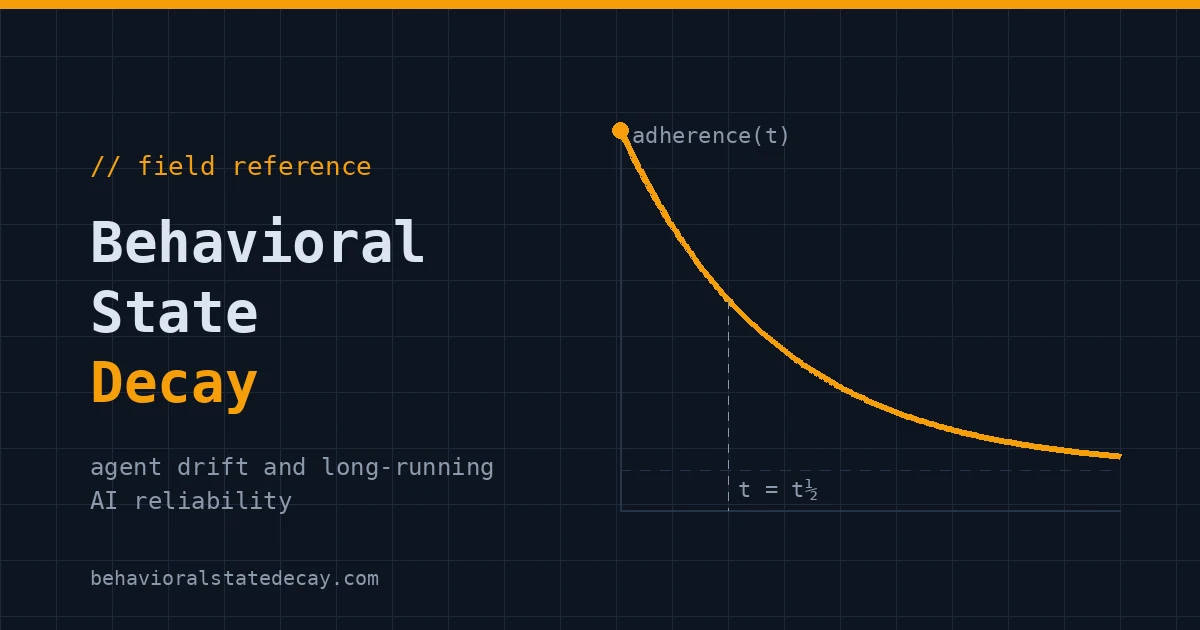
Role drift is the gradual loosening of an agent's assigned identity, voice, and permission boundaries over the course of a session, independent of whether its objective has changed. An agent told to act as a cautious, read-only code reviewer starts proposing edits by turn forty. A support agent instructed to stay formal and refer billing questions to a human starts improvising promises about refunds. In both cases the task the agent believes it is doing may still be correct; what has drifted is the manner in which it does it and the boundaries it respects while doing it.
This distinguishes role drift from goal drift, where the operative objective itself diverges from the assigned one. Role and goal can decay together, since a persona often carries implicit scope ("you only summarize, you do not act"), but they are separable failure modes with separable fixes: correcting a drifted goal means re-establishing what the agent is trying to do, while correcting a drifted role means re-establishing who the agent is being while it does it. Practitioner vocabulary sometimes calls this persona drift or identity drift; this page treats the terms as synonyms for the same phenomenon and uses "role drift" for consistency with the rest of this taxonomy, in the sense laid out in agent drift: a taxonomy.
Mechanism
Role drift has been studied more directly, and with harder numbers, than most of the mechanisms on this site, because it is easy to elicit and measure in isolation: put a persona in a system prompt, run a long conversation, and check whether the model still sounds like the persona.
First, attention decay over turns. A 2024 study built a self-chat benchmark in which two instances of a personalized chatbot converse, then scored how well each stayed in character as the exchange lengthened. It found significant persona drift within eight rounds of self-chat on LLaMA-2-70B-chat, and traced the effect in part to the transformer attention mechanism: as a dialogue grows, the persona instruction sitting early in context receives proportionally less attention weight relative to the accumulating turns (Li et al., arXiv:2402.10962). This is the same positional weakness behind context rot, applied specifically to identity rather than task instructions.
Second, a scale paradox. A follow-up study evaluated identity consistency across nine LLMs in extended, personal-topic dialogues and found that larger models experienced greater identity drift, not less, and that assigning the model a predetermined persona did not reliably strengthen identity maintenance across turns (Choi et al., arXiv:2412.00804). More capable models are not automatically better at staying in character; capability and persona stability are separate properties, and a bigger context window or a more detailed persona prompt is not a guaranteed fix.
Third, an activation-space account of why. A 2026 mechanistic study identified what it calls an "Assistant Axis," a dominant direction in a model's internal representations corresponding to how strongly it is operating in its default assistant identity. The paper reports that conversations demanding meta-reflection on the model's own processes, or involving emotionally vulnerable users, push activations along this axis toward alternative identities most often, and that post-training gives models only a loose tether to their intended persona region rather than a hard constraint (Lu et al., arXiv:2601.10387). Restricting activations to a fixed region along that axis stabilized behavior in the paper's tests, which is a model-internals version of the same idea this page applies at the harness level below.
Fourth, permission collapse. In agent deployments, a role usually does double duty as a safety boundary: "read-only reviewer," "cannot send external email," "escalate rather than promise." When persona coherence loosens, the boundary it was carrying loosens with it, and the agent's own earlier in-role outputs get read back as precedent for looser behavior, the self-conditioning mechanism described in behavioral state decay. This is why role drift is worth tracking separately from a personality quirk: the operational risk is not tone, it is scope.
How to measure
- Role restatement probes: periodically ask the agent to state its role, voice, and any hard constraints, and diff the answer against the original role definition, the same technique used for goal probes in goal drift.
- Self-chat or paired-instance drift scoring: run the agent against a copy of itself or a scripted counterpart over an extended exchange and score persona consistency at intervals, following the self-chat methodology of Li et al. above; this isolates role stability from task performance.
- Permission-boundary telemetry: log every action the agent takes that falls outside its declared role's tool or action allowlist, even when the harness blocks it. A rising rate of near-boundary or blocked actions is an earlier signal than a rising rate of actual violations.
- Style and voice classifiers: formality, verbosity, and hedging language tend to shift measurably before an outright role violation occurs, and are cheaper to compute than a semantic identity check on every turn.
- Fold role-consistency checks into a replayed suite, per drift regression tests, and into a composite score such as the Agent Stability Index, which already tracks behavioral boundaries as one of its scoring categories.
Mitigation
Role pinning is the pattern of keeping an agent's identity and permission boundaries anchored independent of context growth, rather than trusting a system-prompt persona written once at minute one to hold for the life of the session.
Treat the role definition as external state, not conversational context. Store it as its own artifact, separate from the goal anchor, per state externalization: a short, behaviorally specified statement of who the agent is and what it must never do, owned by the operator and never edited by the agent. Re-inject it on its own cadence, distinct from goal re-anchoring, since the evidence above suggests role and goal can decay at different rates; the re-anchoring patterns page covers the injection mechanics.
Enforce the permission boundary structurally, not conversationally. The mechanistic finding that restricting a model's internal activations to a fixed region stabilizes its behavior has a practical harness-level analogue: do not rely on the model continuing to remember and self-apply "I am not allowed to do X." Encode X as a tool-level allowlist or a hard denial the harness enforces regardless of what the model currently believes its role to be. A role statement is a description for the model; a permission boundary should be a constraint enforced outside it.
Prefer narrow, single-purpose agents to one broad-role generalist. A sub-agent instantiated fresh for a narrowly scoped task starts with no accumulated pressure toward an alternate identity; splitting a long, multi-mode session into several short single-role ones removes the extended-conversation precondition that the mechanistic studies above associate with drift, at the cost of coordination overhead between the pieces.
Keep the persona short and behavior-focused rather than long and characterful. This follows from the scale-paradox finding above only loosely, since that study varied model size rather than prompt length; treat a terse, testable role statement ("summarize only; never edit; escalate refund requests") as a reasonable default in the absence of a study isolating persona-prompt length as a variable, not as a proven fix on its own.
Related terms
- Behavioral state decay: the umbrella phenomenon; role drift is one of its identity-level mechanisms.
- Agent drift: a taxonomy: the broader classification role drift sits within as a practitioner-level label.
- Goal drift: objective-level divergence, separable from but often compounding with role drift.
- Context rot: the positional and attention-based degradation that role drift's attention-decay mechanism draws on.
- Re-anchoring patterns: the injection mechanics role pinning relies on.
- State externalization: where the pinned role definition should live.
FAQ
Is role drift the same as goal drift? No. Goal drift is divergence in what the agent is trying to accomplish; role drift is divergence in the identity, voice, and permission boundaries it uses while pursuing that goal. An agent can drift on one axis without the other, though a role often carries implicit scope that makes the two compound in practice.
Does a longer, more detailed persona prompt prevent role drift? Not reliably. The cited study across nine LLMs found that assigning a predetermined persona did not consistently strengthen identity maintenance, and that larger, more capable models drifted more, not less (Choi et al., arXiv:2412.00804). Persona detail is not a substitute for re-anchoring or structural permission enforcement.
Is role drift just a personality quirk, or does it matter operationally? It matters when the role was also carrying a permission boundary. A support agent sounding slightly less formal by turn thirty is cosmetic; a support agent that has quietly stopped treating "never promise a refund" as binding is a permission failure wearing a persona costume. The mechanistic research above found drift most pronounced in conversations involving meta-reflection or emotionally loaded exchanges with the user, which are common in exactly the customer-facing deployments where the permission boundary matters most.